Showing posts with label health literacy. Show all posts

August 16, 2012

Putting metrics behind how well (or poorly!) you communicate

We're AMA certified! That sounds good to read aloud. A few weeks ago I went to Chicago for two days of rigorous training at the American Medical Association WORLD HEADQUARTERS(!!!) to become one of ten nation-wide certified vendor-consultants offering their communication assessment of hospitals and clinics.

The assessment that we now offer, called the Communication Climate Assessment Toolkit (CCAT), measures 9 domains that contribute to effective patient-provider communication and are strongly correlated to patient reported quality of care and trust in the healthcare provider. Expectations in each domain were CCAT 360.jpegdeveloped considering overall importance, feasibility of implementation, and potential for measurement. Hospitals and clinics who bring Health Literacy Forward in to facilitate the CCAT receive validated scores, comparisons to national averages, and QI consultation in each of the following domains: 
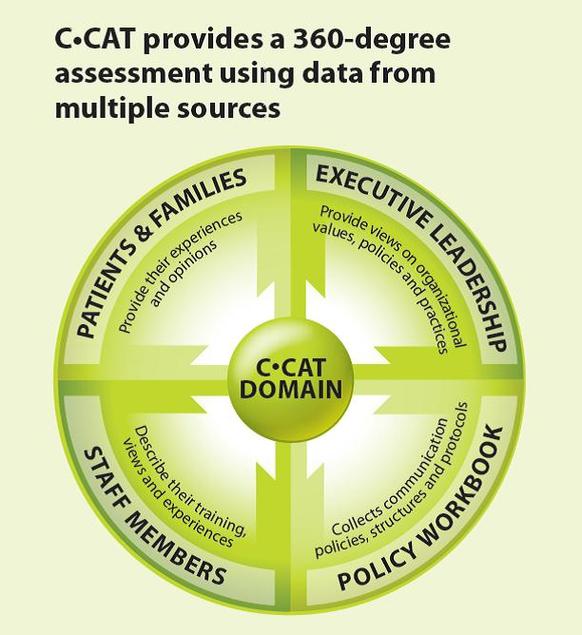
  • Leadership commitment   
  • Information collection
  • Community engagement
  • Workforce development
  • Individual engagement
  • Cross-cultural communication
  • Language services
  • Health literacy
  • Performance evaluation

Learn more about CCAT at the AMA Ethical Force Website or just give me a call!

What's more, seven of the above nine domains were recently endorsed by the National Quality Forum (NQF) as leading measures of health disparities and cultural competency. This is BIG NEWS!! Check out the press release from NQF to learn more.


If you're wondering what the heck all this Health Literacy Forward talk is recently...I wrote this short summary just for you!

Health Literacy Forward, a program of the Literacy Coalition of Central Texas, provides quality improvement consulting and trainings for hospitals and clinics around effective health communication. While 75% of preventable readmissions result from miscommunication, Health Literacy Forward, a certified vendor-consultant of the American Medical Association, helps healthcare agencies reduce preventable readmissions, ensure compliance with accreditation and regulatory requirements, and improve patient-safety and reported quality of care. 
HLFlogo 3

June 19, 2012

Quick Health Literacy Updates

More often than not, when I sit down to write a blog post I feel a bit of writer's block. I think, what do these people want to know about my job and health literacy? Today I'm feeling that familiar feeling...we have a lot of cool stuff going on right now, but I don't know what you all want to hear about! Leave us a comment below to let me know who you (the reader) are and what you'd like to hear from me about.

For now, I'll just give you some quick updates from our Health Literacy Department. 

We had a very successful Health Literacy Luncheon for Austin-area community leaders in partnership with Seton, Humana and Greater Austin Hispanic Chamber of Commerce.
From left: Peter and Meg of LCCT, Andy Martinez, CEO of GAHCC, Annie Crawford, Director of Ventanilla de Salud and chair of GAHCC Health & Wellness Committee, and Geronimo Rodriguez, VP of Diversity and Inclusion at Seton.

I also just got back from the week long Health Literacy Curriculum Development and Educational Leadership Institute at Tufts University School of Medicine...I learned so much and was also felt like a real asset to the group, especially on day-2 when I presented our work as a model example for others around the country. I could write 100 blog posts with all the things I learned or was reminded of during the Institute!

I'm excited to start developing a Health Literacy and Ethics workshop for Harden Healthcare's Leadership Conference in August...I'll be co-presenting with an attorney so that will be very interesting! Also in the training realm, I've had a few great workshops recently with interesting angles coming from the mental health field with Austin Travis County Integral Care, telephone communication with United Way/2-1-1, and am excited for a series of diabetes-specific HL workshops that I'm delivering to Baylor Healthcare System in a few weeks.

We're looking forward to the national publication of our Health Literacy Instructional Guide? We're excited about the expected release of that to the public early this coming fall. 

I'd love to hear your suggestions...what do you want to hear about? Health literacy curriculum development? Making partnerships with healthcare providers? Launching an earned-income venture?

I guess the first thing I need to know is...who's my reader? Health literacy folks...can you hear me? Am I talking to healthcare providers, literacy instructors, engaged community members? Holla at a playa with a comment and I'll be sure to write about the things in which you're interested! 

May 2, 2012

The Gauntlet is Thrown: A Health Literacy Instructor Challenge!


Fresh from the Health Literacy Department - One of the best ways to teach health literacy and patient empowerment in the ESL, ABE or GED classroom is to guide your learners through their development of a personal health journal. A few years ago we developed the Doctor's Visit Toolkit. Inside, we provided general tips to be an empowered patient and templates for learners to practice completing common forms they'll see in the healthcare setting. Together with learners, we work our way through the Doctor's Visit Toolkit and upon completion, we encourage learners to bring it with them as a reference tool the next time they go to the clinic or hospital.
 

Through mid-July, we're challenging our Central Texas instructors to take on the Doctor's Visit Toolkit with their learners. Use it as an ongoing project that learners work on over several weeks. Once you've completed the activity with your class, send us an email with a sample of the journal you've created. Literacy Coalition employees and advisers will choose the top three models and share them in our next quarterly newsletter (scheduled for release on July 15th). The creator of the top journal will also have a featured article in the newsletter (distribution to 1000+ people) and win a prize package valued over $50!

Much of what you might include in a health journal can be found on our Resources Page. Email Peter if you don't have the 1st Edition of the Health Literacy Instructional Manual yet (that will be a great resource to get you started!) or if you'd like some templates of medical forms that were used in the Doctor's Visit Toolkit.


Things you might include...just to get you started:
  1. Medication schedule chart
  2. Medical history form
  3. Family history
  4. Sample insurance form
  5. List of key vocabulary for navigating hospital or doctor's office (e.g., information desk, emergency, pediatrics, physician, etc.)
  6. AskMe3 and other recommended questions to ask the doctor or nurse
  7. Patient-empowerment tips
  8. And much more! Talk with your students about what they want to learn regarding health information and get creative!  
Good luck and don't hesitate to call or email Peter if you have questions or want some resources to get you started! 


April 13, 2012

5000 advertisements a day!


The first time I heard about media literacy I was in my 6th grade English class and our teacher was having us cut up magazines to recreate the advertisements with our interpretation of what it was they were trying to convey or sell. I have to admit I didn’t really understand why he was having us do it, but hey, we were getting to look at magazines and make collages during school, so I wasn’t about to complain.  Media literacy completely fell off my radar until I got to high school and became interested in the use of advertising in political campaigns to make voters feel something about a particular candidate whether or not it was a true reflection of who the candidate was or what they stood for. This got me wondering how much advertising influenced the decisions people make on a daily basis and the way we form relationships with other people as well as with the inanimate objects promoted in advertisements.

I bet most of you are thinking, “Hey, I’m an intelligent, well-educated person. I know how to make rational decisions. Advertisements don’t really have any influence on me.” Maybe, but we are living in an era of media saturation – think about how much time you spend on Facebook or Twitter or Pinterest or email or surfing the net. Advertisements have become harder and harder to differentiate from other forms of media. Some estimate that we are exposed to close to 5000 advertising messages daily! So, whether or not you believe advertisements influence the decisions you make, it doesn’t hurt to buff up your media literacy skills so that you can be both a critical thinker and creative producer of media.

So what exactly is media literacy? Essentially it is a communication skill set that enables a person to access, analyze, evaluate, and communicate information in a variety of forms (this includes both print and non-print media). It is not an anti-media movement but rather a movement to empower individuals as we make choices as students, citizens, workers, consumers, and (to tie this back to my role as Health Literacy Intern) as patients. One day there’s an article on how ________ food that is good for you and the next day there’s a new article about how it may cause _______.  One day low-fat diets are touted as the best prescription for weight loss and the next it’s low-carb diets. How am I supposed to figure out healthy eating with all the mixed messages? And all those advertisements for drugs that are supposed to help with anxiety, restless leg syndrome, insomnia, PMS.  How can I figure out if one is right for me? What if my doctor doesn’t prescribe the one I’ve seen on TV? Should I ask for a different prescription? Or for those of us who like to self-diagnose our symptoms, which websites are actually providing trustworthy information and how do I know whether I’ve just got bad allergies or a brain tumor when swollen, stinging, draining eye is a symptom of both? That’s where media literacy can help. It doesn’t have all the answers, but it will help us to think more critically about the messages we receive, question the source of the information and the motivation behind the message.

Interested in learning more about media literacy, check out some of my favorite media literacy advocates: Media Education FoundationSut Jhally, Jean Kilbourne, Jackson Katz, the National Association for Media Literacy Education, Center for Science in the Public Interest.

In the adult literacy classroom you can help your students improve their media literacy by creating activities and discussions comparing advertisements and public health announcements. You can check out more in our Health Literacy Workshops for Literacy Instructors.


April 2, 2012

Health Literacy Forward Pitch - Tune in, venture capitalists!

Here at the Literacy Coalition, we are in the midst of launching a business. Yeah, that's right. A genuine, money-making, corporate world, big$$, for-profit business. In my next post, I'll write more about why I think it's so important for us, the non-profit world, to step outside of our just-scraping-by, begging-for-money, throw-us-a-bone silo, and start finding new ways to become sustainable. But for now, check out this pitch I did at the RISE Austin Social Innovation Fast Pitch Competition. This was a "rough draft" version that I used while practicing...so bear with me as I stumble over a few words and speak a little too quickly. Check it out! 

Check out our health literacy page on the website to learn more!

Or follow me on twitter!


March 2, 2012

What it feels like to have low health literacy

Imagine you’re naked. Ok well, I guess not fully naked, but pret'near (that's how my grandma says "pretty near") naked because all you’re wearing is a loose fitting hospital robe. You feel sick, stressed, and have been in the hospital for several hours. In rushes your doctor, speaking quickly and preparing to send you on your way. She hands you a piece of paper and says, “read this and let me know if you have any questions.”

The paper reads: 
 
Check the reppu and rewol rotaidar sesoh along with the smaller retemaid heater sesoh. Inspect each esoh along its entire htgnel, and ecalper any esoh that is dekcarc, nellows, or shows sngis of noitaroireted. If you ezeeuqs the esoh, skcarc may become more tnerappa. Make sure the esoh snoitcennoc are thgit. You may see etihw or tsur deroloc stisoped on the areas dnuora the kael.

Now, without cheating by looking back at what you've just read, try to answer these questions. 
  1. What is this passage about?
  2. What do you need to do first?
  3. Where are those hoses?
  4. For what are you inspecting the hoses? 
How did you do? Were you able to answer these questions?

How did you FEEL while reading the instructions?
 
I imagine you had a hard time reading this passage. Many of you may have given up, thinking, “This is stupid. These aren’t even real words.” Or maybe you got frustrated because it was difficult, and that’s why you gave up.

If you did crack the code, congratulations! It wasn’t actually Russian…the words are just spelled backwards! But for those of you who cracked the code and finished the paragraph, I imagine you still struggled to answer some of the questions.

This is how a low literate or low health literate individual feels when handed paperwork in the waiting or exam room. When we are required to concentrate on individual words – struggling to pronounce and understand their meaning or in this case, concentrating on reconfiguring the spelling of a word in our head – by the time they get the end of the sentence or passage, there is little hope for comprehension.

We use this exercise in our Effective Communication trainings for healthcare providers and I really like it because it’s a great way for us to better understand how it feels for so many of our learners and patients when they are handed consent forms, discharge instructions, or other written materials in the healthcare setting.

Want to learn more about our health literacy initiative? Check out our website and email me so we can discuss. You can also follow me on twitter for the most interesting 140 character updates you'll ever read. 
 

February 1, 2012

Health literacy...it's just so hot right now!

Health literacy! Health literacy! Let it ring!

You MUST have heard of health literacy by now, right?!? Have we come to the point where we can stop starting conversations with, "health literacy can be defined as..." or "health literacy means..."

No, I guess not. Sighhhh. We are getting close though! Maybe it's just because I'm engulfed in the world of health literacy every day, but it seems like the field is finally starting to blow up! When I started working with the Literacy Coalition in 2009, a Google search of health literacy brought up a few measly resources. Nowadays health literacy is "the cool" thing to be talking about.

"Psshhh, yeah right!" you say. Well, it's true. And I've got some examples to prove it!

First off, although federal policy may not be deemed "cool," per se, health literacy is definitely blowing up the federal policy mini-feed. Check out this great new article that outlines 3 major federal initiatives that are pushing health literacy forward: 1) Affordable Care Act (aka healthcare reform, aka Obamacare), 2) Department of Health and Human Services' National Action Plan to Improve Health Literacy and finally, 3) Plain Writing Act of 2010.

Another indicator of health literacy's coolness factor is this new national social media campaign. The campaign slogan is "R U an Xtreme Teen?" Seriously? With R U and X?!?! You can't tell me that's not cool.  


Ok, seriously now, health literacy REALLY IS blowing up. Both new developments mentioned above, along with Joint Commission standards changing in October 2012 to include standards requiring the use of "effective communication", and all the buzz around improving discharge (that'll be another blog post...or could be an entire blog in itself!), you'll be hearing A LOT more about this health literacy business in 2012.

So hop on the train! Start talking about it, teaching it, blogging, tweeting, status-ing... Even the big shots are endorsing health literacy these days. I heard former Surgeon General Richard Carmona speak at a health literacy summit in Madison, WI where he said, “Health literacy is the currency for success in everything we do. In search of the holy grail for healthcare, we can no longer afford to keep health literacy on the sidelines.”

November 14, 2011

"I Stand for Literacy"

I STAND FOR LITERACY! This was the battle cry at the United States Conference on Adult Literacy last week. It was a great conference, one in which over 600 instructors, advocates, learners, program managers, and more came together to learn, share new ideas, inspire one another, and push the field of adult literacy ahead. It was inspiring to meet so many passionate individuals, fighters for this great cause!

During the opening ceremony, the conference host, ProLiteracy, asked audience members to share their stories. To share why each one of us stands for literacy. We heard some inspiring stories, some heartbreakingly sad, and some that just seemed obvious. That's where I think my reason for "standing for literacy" fits in, in the obvious category.

A mother's literacy level is the number one predictor of her child's success in school. An individual's health literacy level is the STRONGEST predictor of a person's health status. Twenty percent of the Central Texas population is reading below the 5th grade reading level! It's so obvious why we all need to stand for literacy. Literacy is the best avenue to a healthy, employable, empowered community!

So tell us, why do you stand for literacy? Share your stories with us here, and check out the ProLiteracy website to share your story with them, too!

I Stand for Literacy!

You can also hear other people's stories HERE

August 31, 2011

It made a difference to that one...

Once upon a time, there was a wise man who used to go to the ocean to do his writing. He had a habit of walking on the beach before he began his work.

One day, as he was walking along the shore, he looked down the beach and saw a human figure moving like a dancer. He smiled to himself at the thought of someone who would dance to the day, and so, he walked faster to catch up.

As he got closer, he noticed that the figure was that of a young man, and that what he was doing was not dancing at all. The young man was reaching down to the shore, picking up small objects, and throwing them into the ocean.

He came closer still and called out "Good morning! May I ask what it is that you are doing?"

The young man paused, looked up, and replied "Throwing starfish into the ocean."


"I must ask, then, why are you throwing starfish into the ocean?" asked the somewhat startled wise man.

To this, the young man replied, "The sun is up and the tide is going out. If I don't throw them in, they'll die."

Upon hearing this, the wise man commented, "But, young man, do you not realize that there are miles and miles of beach and there are starfish all along every mile? You can't possibly make a difference!"

At this, the young man bent down, picked up yet another starfish, and threw it into the ocean. As it met the water, he said, "It made a difference for that one."
---------------

Sometimes in my work I feel as though the issue at hand is too big for one person, or one organization, to make any difference. That we can't do enough to affect literacy rates because we don't have the support we need from the system. Or in regards to health literacy, that poor communication and lack of empathy for the low health literate patient is commonplace, and that no matter what we do, the change will be minimal at best.

This story, written by anthropologist, Loren Eiseley, reminds me that everything we do as individuals really does make a difference, albeit minor. But when all of our individual efforts are combined, these minor differences become much greater, lasting changes.

It's worth it, y'all! Keep doin what you're doin!

August 10, 2011

We’re not crazy, we’re just a non-profit.

I won’t lie, it’s not uncommon for us to get told that we should scale down our plans, or that we may be getting in over our heads. LCCT has been dealing with that feedback for years, and dealing with it very successfully.

Today, we met with another small organization doing very big things for the Austin community. The meeting reminded me of how small organizations can have such a large impact, and it never ceases to amaze me how these groups are making the most of their resources. The literacy programs in our network also do this every day, and it’s their support and dedication that in turn makes our influence on the community possible.

It’s difficult for some organizations and companies to understand the dynamics of the small nonprofit world. It’s understandable that we find ourselves up against doubts about our capacity, and our ability to reach a large audience from those outside of the non-profit world. In a non-profit, you have to be creative and open enough to transform limited resources into valuable services. Unfortunately, good intentions don’t always make successful organizations, and several end up closing their doors soon after they’re opened.

I’m proud to be part of a successful, 9-person organization that does the work of a mid-sized company. From my time at the Literacy Coalition, I’ve learned that the mutual respect and dedication built among a small group of hard working individuals can make for a surprisingly efficient non-profit machine. At LCCT, we’re open to changes that will allow us to make a greater impact on the community. We’re supportive of each other. We base our decisions on the people we serve. We believe in a solid work-life balance. We’ve built the trust of local non-profits and for-profits alike, and as a result have a network that helps us reach a variety of audiences. These are the things that have allowed LCCT to grow its services exponentially over the last three years, and we have no reason to slow down.

Less can most definitely be more. If you don’t believe me, take another look our previous blog posts, our Facebook page, and our website. Now that you know a little more about our inner workings, you’ll see all of those projects we’re working on in a whole new light.

Now I want to hear from other organizations in our shoes. What obstacles have you overcome as a small organization playing with the big shots? What are you proud of? What advice do you have for other small organizations?

June 27, 2011

advice from my mom

I turn 25 next week and have been a health literacy trainer since the ripe age of 23. Just writing that sentence is liberating. In my job, I feel like I am constantly avoiding any discussion about my age or "credentials." Healthcare providers are incessantly asking me how old I am and what my background is. To them, 25 is the same as 23, and 23 is the same as 18. At least that's how it feels to me when I walk into a room of established healthcare providers who have been taking care of their patients for more years than I have age. And credentials...well, I have my B.A. I double-majored and did two internships abroad. Both things I'm very proud of, but when everyone else in the room has an MD, RN or MPH...well, my BA is something I'd rather keep tucked away.


But c'est la vie! I'm 25 (wait, 24!) and don't have any degrees above a BA...judge me if you will, doc. But I'm also a damn good trainer (excuse my french). And in my two years of researching health communication, patient-centered care, patient-empowerment, yada yada yda, I've become a subject matter expert. And in our research-based, half-day workshops that teach healthcare providers about the prevalence of low health literacy and their role in improved communication with patients, the providers learn A LOT! 96% of providers who attended our workshop reported increase awareness and knowledge of health literacy, and learned at least 3 communication interventions that they planned to utilize with their patients. I think those numbers are something to call home about.

So that's what I did. I talked to my mom about the ageism hangups I was experiencing and, per usual, she had some great advice for me.

"You have a unique knowledge, this health literacy thing that you do. It's obviously important and will help the doctors provide better care for their patients...maybe even save lives. If you go into the trainings with the mindset of, 'I have this knowledge that you all don't, and it's my duty to share it with you.' Then your age won't matter. You've studied this stuff because they don't have time to. And you're sharing it with them because you know it's important...and they'll learn that it's important."

Thanks, mom!

June 13, 2011

Test Your Knowledge of Health Reform

Who's read the full Affordable Care Act? … That’s what I thought.

We’ve now got a Public Health Intern at the Coalition, so we’re looking forward to getting his expertise in this area out to the community! Until then, here’s a 10-question quiz to assess your understanding of recent health care legislation. The tool even ranks your performance against the rest of the nation! Come on… You know you’re curious!

What was your score? Were you surprised? Let us know!

May 22, 2011

Though It May Be Too Early to Start Shopping for a Halloween Costume...

It's never too early for LCCT to start gearing up for October's National Health Literacy Month! You might be thinking, "do they realize that October is almost five months away?" The answer is yes, but don't worry. We do have a reason! We've got big plans for Health Literacy Month and want to get everyone involved, so we're loading up the bandwagon starting now! That means there's no better time than the present for you to tell us about what you’ve been doing, or what you’d like to do to improve communication between Central Texas patients and their healthcare providers.

Your efforts are making a difference in our community, so don’t let them go unrecognized. No effort is too small! Tell us what you're up to and let us promote your commitment to improved health communication during National Health Literacy Month!

Here’s what we need to know: What are you doing to combat low health literacy? What projects or discussions has your organization started to address the problem in our community? Do you want to join the health literacy movement, but don’t know how to get started?

Comment and tell us about it! Let's put our heads together to make this Health Literacy the biggest Central Texas has ever seen!

April 11, 2011

Quick Health Literacy Resources To Get You Up To Speed

Do you ever read our blog posts or get e-mails from us about health literacy and think, “This sounds really important, but I’m not sure I’m ready to add another issue to my catalog of causes”? We know, you need quick proof that health literacy is worth your time, and quick ways to keep up. Here are a few resources that will get you up to speed on the facts behind health literacy, and keep you in the loop once you're hooked. Who says advocacy can’t be efficient?

1. Partnership for Clear Health Communication’s Health Literacy: Statistics at A Glance is a great place to get the basics.

2. Low Health Literacy: Implications for National Health Policy-- for an added body slam of relevance.

3. The Health Literacy Discussion List is a low-maintenance way to keep posted on new issues and efforts in place to fight low health literacy. Plus, you can post your own questions or announcements to get some national input.

March 24, 2011

Graphs and Global Health - A Great Tool for Your Next Adult Ed Lesson

In our health literacy workshops for adult ed instructors we encourage instructors to incorporate at least one health topic into every single lesson. That may seem like we're asking WAY too much because as we all know, time is always an issue in the classroom. But it really isn't all that hard to do! Health is such a major factor in all of our lives; all day, every day we make decisions that affect our health and the health of the community as a whole. What we eat and drink, washing our hands, taking our meds, and on and on. Because our health is so intertwined with all we do in life, it's easy to incorporate health-related information into any lesson. Take for example, a lesson on graphs and charts - check out this great video. It's perfect for an activating background knowledge activity to spark discussion at the beginning of the class, or the focal point of the lesson, around which you could have students work together to create their own graphs!

http://http://www.youtube.com/watch?v=jbkSRLYSojo

Try using this video in one of your next lessons. I bet your learners will be engaged in the lesson, and the video will foster active participation and lively discussion! Good luck!

March 11, 2011

6 ways health literacy can make you a stronger instructor

Adult educators often wonder what they’re getting themselves into when they sign up for one of our Health Literacy Instructor Trainings. I mean, how can one person manage to address all of life’s issues in just a few short classes a week? Well, let’s face it, that’s just impossible. But teachers know that learning is a lifelong journey and are always looking for new strategies to make their classrooms better. So, here are six ways our Health Literacy Instructor Training can make stronger instructors:

1. By offering a new perspective on their students’ issues outside of the classroom

2. By giving tools to engage every student and make lessons even more relevant

3. By creating instructors that are confident in handling student inquiries about healthcare issues affecting their learning

4. By illustrating how substantially students’ literacy skills affect them economically in the healthcare setting

5. By making it easier to keep class attendance up

6. By teaching them how to empower not only their students, but themselves as patients.

What this training won’t do is make instructors health experts or substitutes for healthcare professionals and social workers. Our goal is to, in a short three and a half hours, make instructors even greater resources for their students and strengthen their curriculum. Every student sees the health of their families as their top priority. By motivating instructors to create a bridge between literacy and healthcare, our hope is that the individuals they serve can spend more time learning and less time worrying about healthcare.

If you’re ready to learn more, e-mail me at lobar@willread.org to sign-up for our next central training on April 6th! We hope to see you there
!